Best Marketing Software for Small Businesses
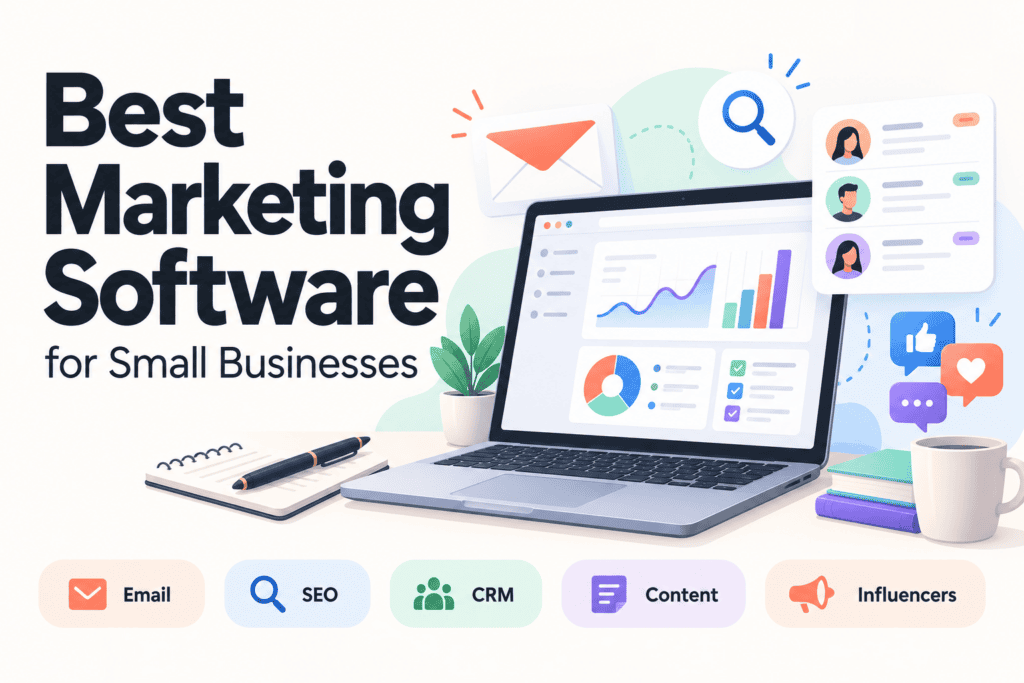
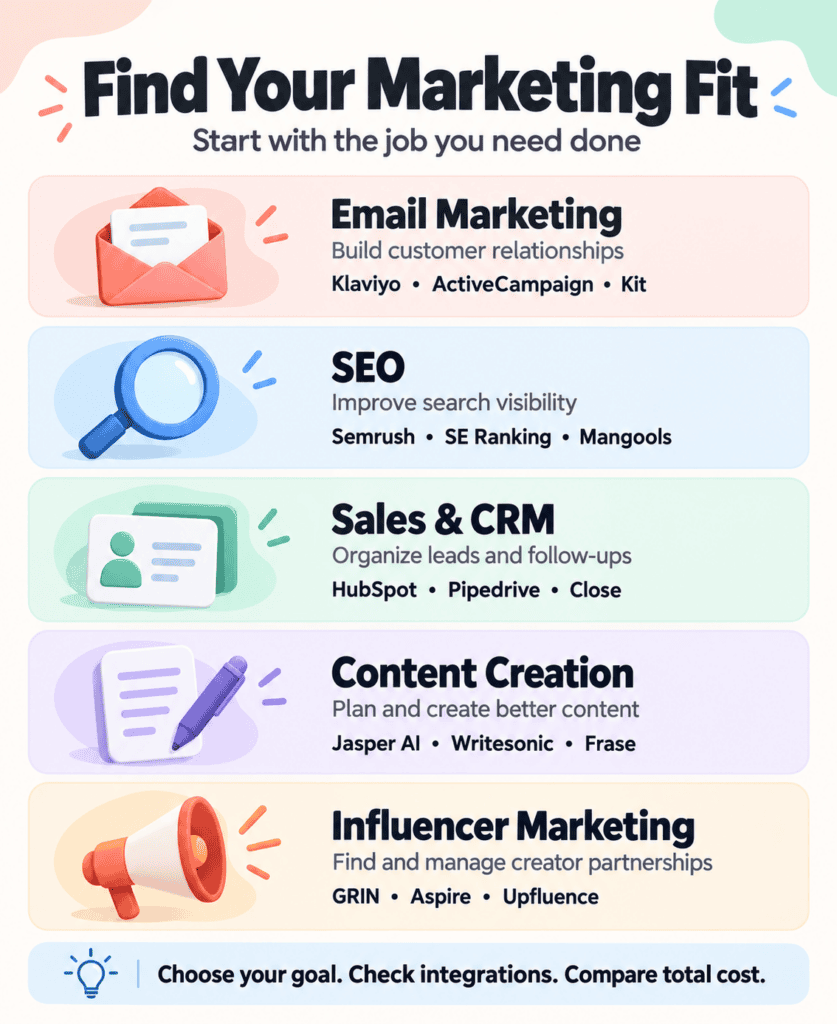
What’s actually broken in your marketing right now? That’s the real question, because “marketing software” isn’t one purchase — it’s five or six different jobs (email, SEO, sales follow-up, content, influencer outreach) that all happen to share a shelf. A tool that’s great at one of those is often mediocre at the rest, and buying a bloated all-in-one platform to solve a problem in just one of those areas is one of the more common ways small businesses end up paying for software nobody on the team actually opens. So rather than ranking everything into one list, this guide walks through each job on its own, with the products worth actually considering for each one and a sense of who each one is really built for.
Your List Isn’t Converting: Email Marketing
If your emails are landing but not converting, the tool is often the problem more than the copy. Klaviyo built its entire product around ecommerce data — order history, browsing behavior, that kind of thing — which makes the segmentation feel less like guesswork than it does in a generic email platform. Klaviyo’s own site leans hard into that Shopify-first positioning, and it shows in how naturally the automations click into place for a store.
If you’re not running a store but you do run complex nurture sequences — lead scoring, multi-branch automations — ActiveCampaign is worth a closer look than Klaviyo; its automation builder was really the whole point of the product long before ecommerce-specific tools caught up. And if you’re a solo creator rather than either of those, Kit (the tool formerly known as ConvertKit) was built around an audience-first relationship rather than transactional ecommerce flows — think newsletters and digital products, not shopping carts. Omnisend sits as the cheaper alternative to Klaviyo for a smaller store that wants SMS bundled in without quite the same price climb as the list grows.
Nobody’s Finding You on Google: SEO Tools
Semrush is the name most people land on first, and for good reason — keyword research, technical audits, and backlink tracking all live under one login on Semrush’s platform. It’s also priced like the all-in-one tool it is, which is more than a lot of small operations actually need if all you’re really doing is tracking a few dozen keywords and fixing the occasional broken link. SE Ranking and Mangools cover the same core workflow — rank tracking, keyword research — at a fraction of the cost, with Mangools in particular built for someone who’s never done SEO professionally.
If your specific bottleneck is writing content that actually ranks rather than fixing technical issues, Surfer SEO is the more targeted pick — it scores a draft against what’s already ranking and tells you what’s missing before you hit publish. And for competitive digging specifically, checking what a rival is spending on ads or which keywords are driving their traffic, SpyFu and Serpstat both do that job well without the full Semrush price tag.
Leads Are Coming In, Then Going Nowhere: Sales & CRM
This is usually where marketing and sales stop being separate departments, and where a lot of small businesses realize their spreadsheet of leads has quietly become a liability. HubSpot makes sense as a starting point mainly because its free CRM tier is a genuinely usable product, not a stripped demo — and it grows into Sales Hub or Service Hub without forcing a platform switch later, which matters more than it sounds like once your contact data has a year or two of history behind it.
For a team that lives in a visual pipeline rather than a full marketing suite, Pipedrive is built around exactly that and tends to onboard faster for a sales-only team. Close CRM goes further still for outbound-heavy teams doing a lot of cold calling and email. Speaking of cold email specifically — if that’s the actual engine behind your pipeline, our Lemlist vs. Instantly.ai breakdown is worth reading before you pick a platform, since the two charge for outreach in almost opposite ways.
You Need Content and Nobody Has Time to Write It
Jasper AI has positioned itself around teams and agencies specifically — brand voice controls that keep several writers sounding like one brand are the real selling point, not raw writing quality. Writesonic covers similar ground at a lower price, and Rytr goes further down that road for a business that just needs the occasional short-form piece without a big monthly bill.
Frase deserves a separate mention because it’s not really an alternative to any of those three — it researches what a page actually needs to cover to compete for a keyword, which pairs naturally with Surfer above rather than competing with Jasper directly.
Influencers Keep DMing You and You Have No System
Once influencer outreach stops being a one-off and starts being a real channel, spreadsheets break down fast. GRIN manages that relationship end to end — discovery, contracts, payments — once you’re juggling more than a handful of creators. Aspire covers similar ground with a different pricing structure, and Upfluence leans harder into discovery specifically, which matters if finding the right creators is the actual bottleneck. Influencity is the lighter option of the four, mostly useful for vetting a creator’s real audience before committing budget.
A Few Things Worth Checking Before You Commit
Whatever you end up picking, a few questions tend to separate a good decision from an expensive one: Can it cleanly import the contact list or data you already have? What does the bill actually look like at double your current size, not today’s size? Is this a point solution doing one job well, or a platform trying to be your whole stack — and are you okay with either tradeoff? And when a tool advertises “AI,” is that feature actually changing your workflow, or is it a thin layer bolted onto something that already existed?
This guide leans on each product’s own pricing pages and the patterns showing up across G2 and Capterra reviews rather than a hands-on run through every tool here — the individual reviews linked above go deeper on that front, including where AppFinderX has tested something directly. For the rest of the marketing category, or to see how these tools stack up against AI-powered options more broadly, the sales and marketing hub and AI-powered software hub are both worth a browse next.