
Frase AI Review: The AI Tool Built to Rank on Google — Not Just Write for It

Frase AI Review: Is Its Full Content Workflow Worth Paying For?
Frase is most compelling when writing the first draft is only one part of your content problem. It brings search research, briefs, AI drafting, optimization, publishing, and ongoing page monitoring into one platform. For a small business with an expanding article library, the attraction is being able to act on research without repeatedly moving work between tools.
That broader scope changes how you should evaluate it. A plan that comfortably covers eight new articles a month might still monitor only a small fraction of your existing pages. AI visibility tracking also varies by plan, and a higher optimization score is not evidence that Google or an AI answer engine will reward the page.
Frase is worth shortlisting for businesses that publish regularly and need a more organized way to maintain existing content. It is harder to justify if you only want occasional AI copy, or if you already have a research and editing process that works well.
This is a research-based review, checked in September 2026. AppFinderX reviewed Frase’s official pricing, product pages, and integration documentation, along with official competitor information. We did not test a paid workspace, publish through its integrations, or independently measure ranking improvements or AI citations. The recommendations and cost scenarios below are our analysis of the documented product.
Start with the brief Frase builds from search results
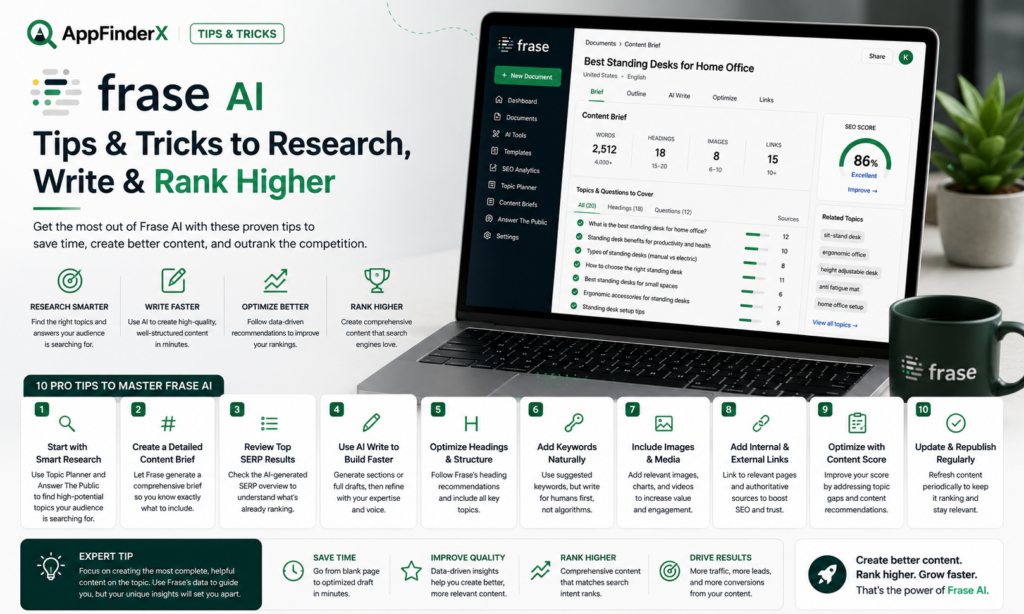
Frase’s research workflow examines pages already ranking for a topic, compares their structure and coverage, gathers searcher questions, and assembles the findings into a content brief. You can adjust the brief before passing it to a writer or using Frase to draft the article. Research can target a particular country and language. Source: Frase SEO research.
That is useful for a business whose content assignments currently consist of a keyword and a vague instruction to write something comprehensive. A structured brief gives the writer a clearer picture of the question, the competing answers, and the subjects readers expect explained.
For example, a commercial cleaning company could research a guide to office cleaning costs. The brief might help organize pricing models, service frequency, and the factors that change a quote. The company would then add the material competitors cannot supply for it: its own scope definitions, actual quotation examples, service exclusions, and regional experience.
That second step determines whether the article deserves to exist. Competitor research provides a useful baseline, but it can also encourage everyone to publish variations of the same page.
Our recommendation is to edit the brief before generating the draft. Remove sections that do not help the intended buyer and identify at least one piece of original evidence the article will contribute. Otherwise, Frase can make an undifferentiated content process faster without making it more useful.
Frase connects drafting with maintenance of older pages
The current product extends beyond researching new articles. Frase describes a workflow that uses your site, search data, competitor coverage, and visitor questions to identify content opportunities. Its Brand Hub supplies voice and content rules for drafts, while publishing connections move approved work into a supported CMS. Source: Frase product overview.
For a small editorial team, the potential saving is administrative as well as creative. A content manager may spend substantial time deciding which older page needs attention, assembling an assignment, transferring the draft, and checking whether the update happened.
Frase is appealing when those handoffs repeatedly stall. It is less compelling when the real bottleneck is obtaining expert input. Connecting research and drafting cannot provide a product test, customer interview, or proprietary dataset that nobody has collected.
There is also an important purchasing distinction: adopting Frase does not require moving your website. You can retain a supported CMS and use Frase as part of the production process. Its own hosting product is optional.
Content Guard helps manage a refresh queue
Content Guard watches selected pages for declining Google performance using Search Console signals. Frase says it examines the current competing results, drafts proposed revisions, and presents a word-level comparison for review. Substantial changes and statistic edits require human approval; users can opt into automatic application of certain lower-risk changes. Source: Frase Content Guard.
The strongest use case is a business with valuable evergreen pages that gradually become outdated. A service guide, comparison page, or buying resource can require attention even while the team is busy publishing something new.
Treat the proposed revision as an editorial assignment, however, rather than a diagnosis proven by the traffic decline. A decrease in clicks does not by itself establish that adding a section or rewriting a title is the correct response. Check whether the suggested change addresses an actual weakness in the page.
There is a documentation detail to verify during setup. Frase’s pricing page describes approved fixes being republished, while the detailed Content Guard page says they return to the source CMS as a draft. Confirm the resulting draft or live status in your own connection before relying on an unattended process.
The page allowance also deserves attention. Starter watches 10 pages, Professional 75, and Scale 300. Those are distinct from the monthly audit allowances. Auditing a large inventory does not mean every page receives the ongoing drafted-fix workflow. Source: Frase plan comparison.
For a 200-article website on Professional, 75 guarded pages would cover 37.5% of the inventory. That can be sufficient if you deliberately select important pages. It is not whole-library protection.
AI visibility and content scores answer different questions
Frase includes SEO and GEO scores, with GEO referring to optimization for generative AI search. Separately, AI Visibility monitors brand mentions and citations for tracked prompts. Its documented reporting includes cited URLs, competitor comparisons, and classification of prompts by buying stage. Source: Frase AI Visibility.
Keep those outputs separate when assessing results:
- A content score evaluates the page against Frase’s own criteria.
- An observed citation shows that a tracked answer included your page or brand.
- A business result concerns what useful visits, inquiries, or sales followed.
An improved score does not demonstrate an improved business result. Likewise, visibility across a selected set of prompts should not be read as visibility across every question a potential customer could ask.
Prompt selection therefore matters. A business should include questions about the problem it solves, comparisons shoppers make, and purchase decisions. A tracking set dominated by queries that already contain your brand name could give an overly reassuring picture.
Plan coverage differs, too. Starter tracks ChatGPT and Google AI; Professional adds Perplexity; Scale adds Claude and Gemini. The corresponding tracked-prompt allowances are 50, 200, and 500. Do not infer that every advertised engine is included in the entry plan. Source: Frase pricing.
AI Visibility monitors and alerts. Content Guard is the separate feature focused on Google performance and proposed page revisions. Frase does not describe AI Visibility itself as automatically fixing missing citations.
Frase pricing and the limits that can force an upgrade
Pricing checked: September 2026. Public prices are in USD. Annual figures below are calculated from the displayed monthly equivalents; they exclude optional purchases and applicable taxes. These are the current Starter, Professional, and Scale packages, rather than older Frase plan descriptions found in historical reviews. Source: Frase pricing.
| Plan | Month-to-month price | Monthly equivalent billed yearly | Seats and sites | Articles per month | Audit pages per month | Content Guard pages |
|---|---|---|---|---|---|---|
| Starter | $49 | $39 | 1 seat, 1 site | 10 | 50 | 10 |
| Professional | $129 | $103 | 3 seats, 5 sites | 40 | 250 | 75 |
| Scale | $299 | $239 | 5 seats, up to 10 domains | 100 | 1,000 | 300 |
| Enterprise | Custom | Custom | Custom | Custom | Custom | Custom |
At the displayed annual rates, the base commitments are $468 for Starter, $1,236 for Professional, and $2,868 for Scale.
Starter stops at its monthly limits until the cycle resets or you upgrade. Professional and Scale offer optional pay-as-you-go capacity, disabled by default. Additional seats on those plans cost $29 per month each.
Professional lists overages of $5 per article, $0.50 per audit page, and $0.25 per AI prompt. Scale lists $4, $0.40, and $0.20 respectively. These charges apply only when the relevant pay-as-you-go option is enabled.
Article counts are not the only production allowance. The comparison also lists separate on-demand AI generation limits of 25, 100, and 350 across the three public tiers. Ask how your intended actions are counted if you expect frequent regeneration or supplementary AI work.
A solo publisher producing eight articles a month
Starter’s article allowance could accommodate this schedule. At $49 on monthly billing, the base subscription works out to about $6.13 per scheduled article if all eight are produced. That calculation allocates the entire subscription to article output; it is not Frase’s per-article price and excludes editing labor.
The limitation may instead be maintenance. A publisher with hundreds of older articles still receives only 50 audit pages per month and 10 guarded pages. Starter fits a modest, prioritized workload better than a large refresh project.
A three-person team producing 45 articles in a busy month
On monthly Professional billing, five additional articles at $5 each would raise that month’s base subscription from $129 to $154, assuming pay-as-you-go is enabled and no other extras are used.
That is substantially below Scale’s $299 monthly price. An occasional five-article excess alone would not justify upgrading. More domains, audit capacity, guarded pages, or broader AI-engine coverage might.
An agency that needs branded client reporting
Scale includes exportable client-ready reports, but Frase reserves white-label reports and branded client portals for Enterprise. An agency requiring its own branding should obtain a quote before treating Scale as its complete delivery system.
This is a meaningful distinction: enough article capacity does not necessarily mean the reporting package meets the client agreement.
Integrations and the publishing handoff
Frase’s documentation lists connections for Google Search Console, Google Analytics 4, Google Docs, and WordPress, among others. Its current publishing destinations include WordPress, Webflow, Sanity, Wix, and FraseCMS. Sources: Frase integrations, publishing destinations.
- Google Search Console supplies actual search-performance data for opportunity identification and page monitoring. Frase’s documentation recommends making this the first connection.
- Google Analytics 4 connects analytics data to the workflow. Confirm that the particular metrics you need appear in the connected workspace.
- Google Docs is listed as an integration for teams using it in their writing process. Test the required handoff rather than assuming complete two-way synchronization.
- WordPress is a supported publishing destination for businesses keeping their existing site. Check the appearance and status of a sample draft before using it for production updates.
- Wix, Webflow, and Sanity are additional supported destinations, reducing the need to manually transfer finished content.
For WordPress teams, a successful connection is only the first check. Use one representative article containing headings, links, images, and a table to assess how the content arrives in your editor and theme. This review did not independently verify those formatting details.
FraseCMS is optional. Its free hosting tier is included with a Frase plan, while Basic and Pro hosting are listed at $19 and $99 per month on top of the content subscription. An existing WordPress site does not need that extra hosting purchase simply to use Frase’s supported WordPress publishing connection. Source: FraseCMS pricing.
Where Frase still needs an editor
Frase’s most important limitation is the distance between a researched draft and an article with something distinctive to say.
Search-result analysis can identify common coverage. It cannot establish that those pages are correct, that their advice fits your customer, or that repeating their structure produces a better answer. An editor still needs to verify material claims and decide which questions deserve space.
Brand voice is similarly useful but incomplete. A draft that sounds like your company can still contain weak reasoning or an unsupported statement. Tone consistency should not be mistaken for factual reliability.
For software reviews in particular, the editorial contribution includes checking current plan limits, explaining realistic costs, distinguishing native integrations from workarounds, and identifying the buyer who should choose something else. A polished synthesis of competing reviews does not supply that work automatically.
There is also a practical cost to maintaining the system. Someone must select monitored pages, review proposed revisions, choose meaningful AI prompts, and evaluate the resulting output. Frase may reduce fragmented work, but the feature list does not establish how much time your team will save.
Alternatives and recommendations
Choose Surfer SEO if your immediate priority is the experience of editing and optimizing articles. Its Content Editor offers live recommendations, an outline builder, collaboration, and publishing-related integrations. Compare the same real draft in both tools to see which suggestions your writers can use. Surfer also offers broader capabilities, so this is a workflow preference rather than a claim that it only edits content. Source: Surfer Content Editor.
Choose Jasper AI if your evaluation centers on broader marketing production, brand governance, and campaign workflows. Jasper’s current platform also includes SEO and AI-search offerings; the distinction is how much of your work extends beyond maintaining a search-focused article library. Source: Jasper platform overview.
Choose Frase if you want research briefs, article production, CMS publishing, and ongoing page maintenance connected in one subscription. It is particularly relevant when content updates keep stalling between diagnosis and execution.
Keep your existing process if you publish infrequently and already have an effective research and editing workflow. A new platform should resolve a recurring problem, not simply provide another place to generate text.
Use the seven-day trial to measure usable work
Frase advertises a seven-day trial with no credit card required. The pricing FAQ specifies caps of five articles, 50 audit pages, 25 AI prompts, and up to three seats. It provides Professional features with trial-specific restrictions, so do not assume every paid allowance or tracked engine is included. Source: Frase trial details.
Use one new article and one existing page as the evaluation. For the new piece, assess the brief, source quality, omissions, and editing effort. For the existing page, examine whether the proposed changes improve the answer and preserve useful original material.
Then test a draft handoff to your CMS and choose a small set of buyer questions for visibility tracking. Measure how much usable work the process produces. Seven days can reveal a poor brief or an awkward publishing handoff; it cannot establish dependable long-term ranking improvement.
Is Frase AI worth it?
Frase’s strongest case is for a publisher or small content team that needs to keep producing and maintaining useful articles with limited staff. Combining those tasks can be more valuable than adding another standalone writer.
Starter is a sensible evaluation point for one person managing a modest schedule. Professional is more practical when collaboration, several sites, or a larger refresh workload matters. Choose Scale for the operational allowances you actually need, and check Enterprise pricing early if branded client reporting is essential.
The biggest compromise is that automation and scoring still require editorial judgment. Buy Frase if a trial demonstrates better briefs, useful revision proposals, and fewer publishing handoffs. If the main benefit is merely more draft text, the broader subscription may not earn its place in your workflow.


