
Lemlist vs Instantly.ai: Which Cold Email Platform Is Better?
Lemlist and Instantly.ai solve the same basic problem — getting cold outbound email into inboxes at scale — but they’re built on almost opposite pricing philosophies, and that difference matters more to most buyers than any single feature. Instantly charges a flat, per-workspace fee with unlimited connected sending accounts, which makes it dramatically cheaper for a small team doing high-volume email-only outreach. Lemlist charges per seat, but bundles true multichannel sequencing — email, LinkedIn, calls, and WhatsApp in one workflow — that Instantly doesn’t offer natively at any price. The right choice depends less on which platform is “better” in the abstract and more on whether your outbound motion is built around volume or around channel breadth.
This comparison is research-based, built from both platforms’ live pricing pages and help-center documentation, plus patterns across thousands of verified G2, Capterra, and Trustpilot reviews — not a hands-on campaign run through both tools side by side.
The Pricing Model Difference That Decides Almost Everything
Instantly bills per workspace, not per person. Every Outreach tier — Growth, Hypergrowth, Light Speed — includes unlimited connected sending email accounts and unlimited automated warmup, and the price doesn’t change whether one person or five people are working inside that workspace. Lemlist does the opposite: every plan is priced per user, and each additional teammate multiplies the bill.
| Lemlist | Instantly.ai | |
|---|---|---|
| Pricing model | Per seat | Per workspace (flat) |
| Entry tier | Email Pro: $69/mo per user ($55 annual) | Growth: $47/mo ($37.60 annual) |
| Mid tier | Multichannel Expert: $99/mo per user ($79 annual) | Hypergrowth: $97/mo ($77.60 annual) |
| Top published tier | Enterprise: custom, 5+ seats | Light Speed: $358/mo ($286.30 annual) |
| Sending accounts included | 3 (Email Pro) or 5 (Multichannel Expert) per user | Unlimited on every tier |
| Native channels | Email, LinkedIn, calls, WhatsApp | Email only |
| Lead database | Bundled (200–400 enrichment credits/user/month) | Separate subscription (Instantly Credits, $9+/mo) |
A single sender comparing the entry tiers sees Lemlist ($69/mo) looking more expensive than Instantly ($47/mo) for what looks like a similar starting point. That gap becomes enormous the moment a team grows, because Lemlist’s per-seat structure multiplies while Instantly’s flat fee doesn’t move.
Where the Math Actually Lands: Solo, 5-Seat, and Agency Scenarios
Run the actual numbers across three realistic team shapes:
Solo founder, email-only outreach: Instantly’s Growth plan at $47/mo covers this cleanly. Lemlist’s Email Pro at $69/mo is the closest equivalent, making Instantly the cheaper choice by a real margin for anyone who doesn’t need LinkedIn or call steps.
Five-person team, email-only: Instantly’s flat-fee model shows its real advantage here. A five-person team can share a single Hypergrowth workspace at $97/mo total. The same five people on Lemlist’s Email Pro plan pay $69 × 5 = $345/mo on monthly billing, or $275/mo annual — roughly three to four times Instantly’s cost for comparable email-sending capability.
Five-person team running true multichannel (email + LinkedIn + calls): This is where the comparison flips. Lemlist’s Multichannel Expert at $99/seat puts that same five-person team at $495/mo monthly, or $395/mo annual. Instantly has no native LinkedIn or call-step equivalent at any price — a team wanting that on Instantly would need to bolt on a separate LinkedIn automation tool, commonly priced in the $50–100/mo-per-user range elsewhere, on top of Instantly’s own $97/mo workspace fee. Once a team genuinely needs coordinated cross-channel sequences rather than two disconnected tools, Lemlist’s bundled $495/mo can end up more predictable — and not necessarily more expensive — than stacking a second platform on top of Instantly.
Agency managing many client domains, high email volume: Instantly’s Light Speed tier ($358/mo, unlimited sending accounts) is built for exactly this — one flat fee covers however many client domains and inboxes an agency rotates through. Lemlist’s per-seat model doesn’t scale the same way for an agency structure unless each client effectively gets its own paid seat, which pushes Lemlist’s real cost well past Instantly’s at agency scale.
One more practical detail that affects how easily a buyer can even run these numbers before committing: Lemlist’s 14-day free trial is only available on the Multichannel Expert plan (annual billing, no credit card required), which means testing the cheaper Email Pro tier isn’t an option without paying first. Instantly offers a free trial across its Outreach plans with no credit card required, making it the easier of the two to sanity-check against a real, small sending campaign before any money changes hands.
Email-Only Volume vs. True Multichannel: What Each Platform Actually Does
Instantly is, at its core, a cold email sending engine — and a genuinely strong one. Unlimited connected inboxes mean an agency or high-volume sender can spread sending volume across dozens of domains without paying more per mailbox, which directly reduces the risk of any single domain getting flagged. Instantly’s lead database (branded Instantly Credits, formerly bundled differently) is a separate subscription layered on top of the sending plan, meaning the advertised $47/mo Growth price covers sending infrastructure only — a buyer who also wants Instantly’s built-in prospect database is realistically looking at close to $94/mo once both pieces are added.
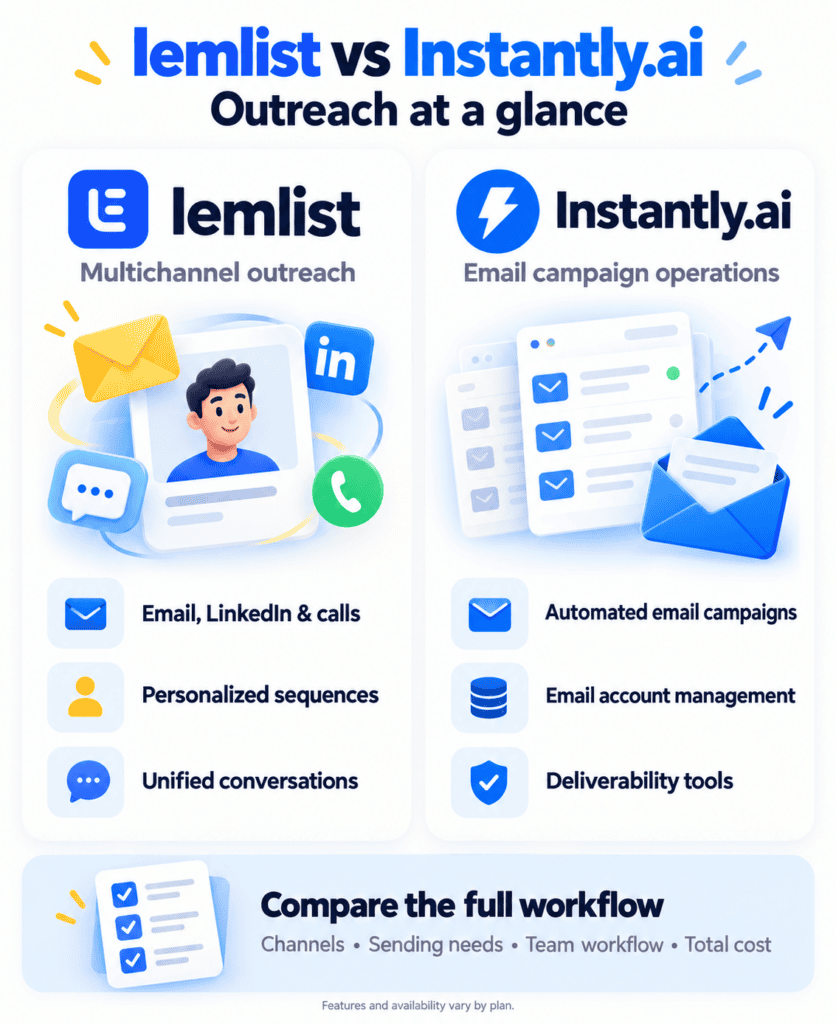
Lemlist’s core differentiator is that email is only one channel in the sequence builder. Multichannel Expert lets a rep combine an email step, a LinkedIn connection request, a manual call task, and a WhatsApp message inside the same automated sequence, with a unified inbox that surfaces replies from every channel in one place. Lemlist also bundles enrichment credits (200 on Email Pro, 400 on Multichannel Expert, per user per month) directly into the subscription rather than selling them as a wholly separate product, which is a meaningfully different packaging decision than Instantly’s split between Outreach and Credits.
Neither approach is objectively more complete — they’re built for different outbound motions. A team whose entire strategy is “send more emails, to more inboxes, more safely” gets more of what it needs per dollar from Instantly. A team whose strategy depends on multi-touch sequences across LinkedIn and email specifically gets something from Lemlist that Instantly simply doesn’t build.
Deliverability and Warmup: What the Reviews Actually Say
Both platforms include automated email warmup, and both market it as a core deliverability feature. The aggregate ratings look similar and strong on the surface — Instantly holds roughly 4.8/5 on G2 across thousands of reviews and a similarly high Capterra score, while Lemlist sits around 4.5/5 on G2 with a smaller review base. Look past the headline number, though, and a specific pattern shows up more often in Instantly’s Reddit and Trustpilot feedback than in its G2 reviews: users reporting that in-platform warmup “heat scores” read high while real campaign inbox placement lands meaningfully lower, along with a recurring theme of slow or unhelpful support specifically during active deliverability problems. This isn’t the dominant sentiment — the large majority of reviews across both platforms are positive — but it’s a documented, recurring complaint pattern worth testing on a small scale before committing serious sending volume to either tool.
Lemlist’s complaint pattern runs in a different direction. Independent analyses of its review data describe pricing satisfaction consistently trailing product satisfaction, with the per-seat structure and add-on credits pushing the real monthly bill 30–50% above the advertised base price for teams that scale past a handful of seats — a criticism that’s really a restatement of the pricing-model difference covered above, rather than a complaint about deliverability or product quality itself.
Choosing Between Unlimited Inboxes and True Multichannel
Neither platform wins this comparison outright, because they’re not really competing for the same buyer. Instantly is the stronger choice for a solo founder, a small team focused purely on email volume, or an agency managing many client domains where the flat, unlimited-inbox fee structure directly protects margin as headcount or domain count grows. Lemlist is the stronger choice for a small, focused team that genuinely runs coordinated email-plus-LinkedIn sequences and would otherwise need to pay for two separate tools — and for a team small enough that per-seat pricing hasn’t yet become the dominant cost driver.
The buyer most likely to make the wrong call here is the one who compares the two entry-tier prices ($47 vs. $69) without accounting for team size or channel needs. A five-person email-only team choosing Lemlist over Instantly is very likely overpaying for capability it won’t use; a five-person team running genuine multichannel outreach that chooses Instantly to save money will likely find itself stitching together a second subscription to replace what Lemlist already builds in — and may end up spending close to the same amount anyway, with more moving parts to manage.
Integrations
- QuickBooks is not a natural fit for either platform’s core workflow, but both integrate with mainstream CRMs: Lemlist connects natively to HubSpot, Salesforce, and Pipedrive, while Instantly’s CRM connections run primarily through Zapier and its own built-in AI-powered CRM feature.
- Zapier — the common bridge for both platforms into tools neither integrates with natively, including most marketing automation and helpdesk software.
- Pipedrive — one of Lemlist’s three native CRM integrations, syncing reply and engagement data directly into deal records.
Alternatives
- Apollo.io — worth considering for a team that wants a built-in B2B contact database and sales engagement tools bundled with sending, rather than Instantly’s separate-subscription approach or Lemlist’s per-seat model.
- Sales and marketing software more broadly, including CRM and email marketing tools relevant to an outbound motion, is covered in AppFinderX’s sales and marketing software hub.

