
Innago Review 2026: The Property Management Platform With No Paid Tiers at All
Innago Review: The Free Software That Tenants Actually Pay For
Innago markets itself, accurately, as free for landlords: no monthly fee, no setup cost, no contract, no cap on the number of units or properties a landlord manages. Our take: that claim holds up under scrutiny, but “free” is doing more work in that sentence than most reviews acknowledge — Innago’s entire business model runs on transaction fees and screening charges paid by tenants and applicants, not by the landlord who chooses the software. Understanding exactly how that fee structure works, and who ends up paying what, matters more to a buying decision than the headline price ever will.
This review is research-based, built from Innago’s own published FAQ and pricing pages along with patterns drawn from more than 500 verified reviews on Capterra and G2, rather than a side-by-side hands-on trial against every competing platform.
At a Glance
- Category: Rental property management software for landlords
- Best for: Independent landlords and small property managers who want core leasing tools without a software bill
- Starting price: $0/month for landlords, with tenant-paid transaction and screening fees
- Free trial: Not applicable — the platform itself has no paid tier to trial
- Standout strength: Genuinely complete free tier with no unit caps
- Biggest drawback: Revenue model depends on transaction volume, which shapes what gets built and supported
- Top alternatives: DoorLoop, TenantCloud, TurboTenant
The Transaction Fee That Funds Everything
Innago’s free model is not a loss leader or a stripped-down trial tier waiting to upsell a landlord into a paid plan — there is no paid plan to upsell into. Instead, the platform is entirely funded by fees charged on the tenant side of the transaction. According to Innago’s own FAQ, ACH bank transfer payments carry a flat $2 transaction fee, while credit and debit card payments carry a 2.99% fee, both charged to the tenant by default. Tenant screening reports — covering credit, criminal, and eviction history — cost $30 to $35, and income verification adds another $10, both paid by the rental applicant rather than the landlord requesting the report.
This is a meaningfully different arrangement than a landlord might assume from the word “free” alone. A landlord using Innago is not simply getting free software; they are getting free software whose costs have been relocated to the people with the least negotiating leverage in the relationship — the prospective tenant deciding whether to apply, and the signed tenant deciding how to pay rent each month.
Innago does give landlords one meaningful lever here: the platform allows landlords to absorb the ACH or card transaction fee themselves rather than passing it to the tenant. Whether that’s worth doing depends entirely on the payment method involved, which is where the actual numbers matter more than the general concept.
What’s Actually Included at No Cost
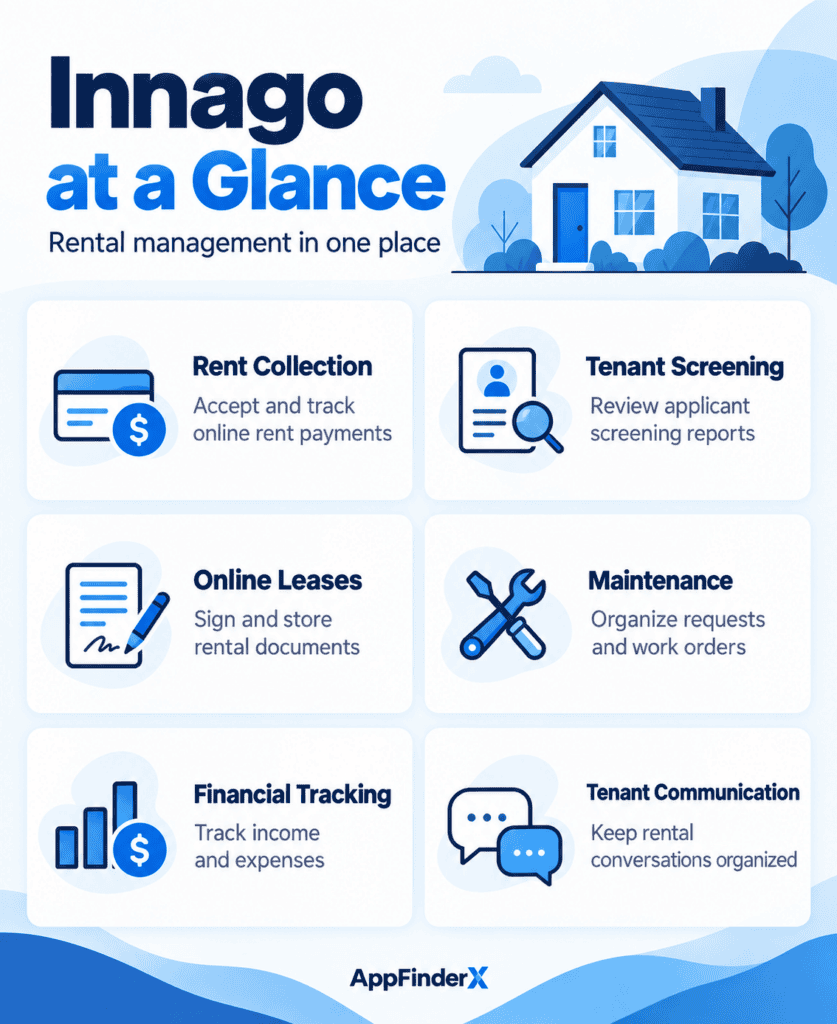
The list of features bundled into Innago’s free tier is longer than the word “free” usually implies in software, and it’s worth spelling out precisely because so much of the platform’s value depends on how complete that free tier really is. Landlords get unlimited property listings syndicated to major rental sites, a built-in rental application with customizable questions, the tenant screening reports described above, a native e-signature tool for lease agreements (including either Innago’s own templates or an uploaded lease), automated rent reminders and late fee assessment, and a maintenance request system that logs and tracks issues from submission through resolution. None of this sits behind a paywall or a usage cap tied to portfolio size — a landlord with 700 units uses the same free tier as a landlord with one, a detail Innago repeats often enough in its own marketing that it’s worth independently confirming, and independent research corroborates it: there is genuinely no unit ceiling forcing an upgrade that doesn’t exist.
That completeness is Innago’s real competitive advantage over free-tier competitors that cap unit counts or gate core leasing tools behind a paid plan. The tradeoff, as the sections below cover, is that a platform funded entirely by transaction volume has less incentive — and often less revenue — to build out the deeper reporting and integration ecosystem that a subscription-funded competitor can invest in.
What a Tenant Actually Pays to Rent Through Innago
Run the math on a $1,500 monthly rent payment across a full year, comparing the two payment methods Innago supports:
| Payment Method | Fee Structure | Monthly Cost | Annual Cost |
|---|---|---|---|
| ACH bank transfer | Flat $2 per payment | $2.00 | $24.00 |
| Credit or debit card | 2.99% of payment | $44.85 | $538.20 |
The gap between these two numbers is the single most important thing a landlord evaluating Innago pricing should understand before deciding whether to absorb fees on a tenant’s behalf. Absorbing a $24-a-year ACH fee across a handful of units is a rounding error most landlords can justify as a tenant-retention perk. Absorbing a $538-a-year card fee on even one unit is a materially different financial decision, and doing it across a multi-unit portfolio would erase a meaningful share of that portfolio’s margin. In practice, this is why landlords who use Innago tend to actively steer tenants toward ACH rather than card payments, either through messaging or through simply not offering to cover the card fee themselves.
The one-time tenant screening cost — $30 to $35 for a full background and credit check, plus $10 for income verification — sits outside this monthly calculation but factors into the total cost an applicant absorbs just to be considered for a unit, something landlords marketing multiple vacancies simultaneously should keep in mind when setting expectations with prospective renters.
Where the Free Model Runs Into Friction
Two limitations show up often enough in verified user reviews to name specifically rather than wave away as generic “cons”:
- Recurring technical glitches. Across Capterra’s aggregated review data, a meaningful share of negative feedback centers on bugs, document misalignment, and general lag — one property manager specifically described “a lot of pop-ups about bugs or something not working” during regular use. This doesn’t appear to be a dealbreaker for most users, but it’s a real and recurring pattern rather than an isolated complaint.
- Reporting depth and integration breadth are limited. Several long-term reviewers note that financial reporting isn’t as customizable as they’d like, and that Innago’s third-party integration ecosystem — QuickBooks aside — is thinner than paid competitors offer. For a landlord who wants deep, exportable financial reporting or a wide integration marketplace, Innago’s free model appears to prioritize core leasing workflow over that kind of depth.
Neither issue erases the platform’s core value, but both are worth testing against a real property during Innago’s no-commitment signup before migrating an entire portfolio’s records onto it. A landlord managing a single unit can absorb an occasional glitch without much consequence; a property manager running Innago across dozens of units and relying on its reporting for owner statements should weigh that limitation more heavily before committing.
Innago Against DoorLoop, TenantCloud, and TurboTenant
Innago’s closest comparison is TurboTenant, since both run on the same fundamental model: free software for the landlord, funded by tenant-paid screening and payment fees. The practical difference between them shows up in the details of that fee structure and in each platform’s depth of native accounting — a distinction covered in more depth in AppFinderX’s TurboTenant review. TenantCloud sits in a different category entirely: it moved away from a free tier years ago and now starts at $18 a month for the landlord directly, trading the tenant-funded model for a more traditional software subscription with deeper accounting and team-management tools built in. DoorLoop goes further still, positioning itself as a paid, full-featured property management platform aimed at operators who’ve outgrown what any of the free-for-landlords tools can do.
Choose Innago if you want a genuinely complete free tool for a straightforward residential portfolio and you’re comfortable with tenants absorbing modest per-transaction costs. Choose TenantCloud if you’d rather pay a flat monthly fee yourself and get more built-in accounting and team tools in return. Choose DoorLoop if your portfolio has outgrown what any landlord-free tool offers and deeper reporting, accounting, and team permissions justify a real software budget.
For a landlord running a handful of straightforward residential units who wants to minimize what they personally spend on software, Innago remains one of the more complete free options in the category — genuinely free, not a bait-and-switch trial, and functional enough that many long-term users report no reason to ever upgrade to something else, because there is nothing to upgrade to. The tradeoff is a business model that depends on transaction volume rather than subscription revenue, which shapes what gets prioritized in the product roadmap and support queue, and a fee structure that, while transparent once you know where to look, isn’t obvious from Innago’s own homepage messaging. Landlords who read past the word “free” and understand exactly which payment method their tenants will use are the ones who get the most value out of Innago; landlords who assume “free” means “free for everyone in the transaction” are the ones most likely to be surprised by a tenant’s complaint about a card fee six months in.
None of this makes Innago a weak pick for “best free” status in the category — a fair Innago review still likely places it near the top. It simply means the honest way to judge Innago pricing is against the total cost the rental relationship generates, tenant fees included, rather than against the landlord’s own bank statement alone.
Integrations
- QuickBooks — the platform’s most substantive third-party integration, automating bookkeeping data entry across multiple properties or entities.
- Zillow — one of the major listing sites Innago syndicates vacancy postings to at no charge.
- Apartments.com — another primary listing syndication partner for filling vacancies directly from the Innago dashboard.
Alternatives
- TenantCloud — the better fit for landlords who’d rather pay a flat monthly fee themselves in exchange for deeper accounting and team tools.
- TurboTenant — the closest philosophical match, running the same tenant-funded free model with a different fee structure and native accounting.
- DoorLoop — worth the paid subscription for portfolios that have outgrown what a free landlord tool can support.


