Canva Review: Can a $14-a-Month Tool Really Replace Your Design Team?
Canva Review: What You’re Actually Paying After Two Years of Price Hikes
If the last price you remember for Canva Pro is $12.99 a month, that number is out of date. Canva has raised Pro’s price twice since late 2024 — first to $15, then to $18 on monthly billing — and rebuilt its team plan from a flat-rate structure into per-seat pricing along the way. Multiple independent pricing trackers checked as recently as July and August 2026 confirm the same pattern, which makes Canva’s pricing history, more than any single feature, the thing worth understanding before comparing it to Adobe or Figma.
That history matters for a practical reason: a lot of the pricing guidance still circulating online — “$10 a user,” “$12.99 Pro” — reflects a version of Canva that no longer exists for new signups. Existing subscribers on some legacy plans may have kept older rates for a period, but anyone evaluating Canva fresh in 2026 is looking at a meaningfully higher price than the tool’s reputation as a budget-friendly option might suggest.
The Current Pricing, and Why It Keeps Moving
Free remains a genuinely usable tier rather than a stripped-down trial — a large template library, basic Magic Studio AI with a modest monthly credit allowance, and 5GB of storage.
Pro runs $18 a month on monthly billing, or roughly $12–15 a month on annual billing depending on when and where the rate is checked — Canva’s pricing pages have shown enough regional and timing variation that the exact figure is worth confirming at checkout. Pro adds Brand Kits, the fuller Magic Studio AI toolset, a background remover, and priority support.
Business (the tier formerly called Teams, rebuilt into per-seat pricing in September 2024) runs roughly $25 per user per month on annual billing, with no seat minimum. It adds shared brand controls, approval workflows, a larger AI credit pool, and up to 500GB of shared storage.
Enterprise is custom-quoted, and according to at least one recent pricing analysis, effectively requires a 150-seat minimum commitment — which means a 40-person team that wants Enterprise-grade security controls doesn’t actually have the option to buy them at that size; it either stays on Business or over-commits to a seat count it doesn’t need.
Pricing checked: August 2026, based on multiple independent trackers reporting figures consistent with each other for mid-2026; Canva’s own pricing has moved often enough in the past two years that confirming the live rate before budgeting is genuinely worth the extra step, more so than with most software in this category.
The AI Costs That Sit Outside the Subscription
Canva meters its heaviest AI features — image and video generation through Magic Media — against a monthly AI credit allowance that scales with plan tier. Free users get a small allowance; Pro and Business get considerably more, and everyday actions like Magic Write and basic Magic Design draw from the same pool without necessarily needing much of it. For a business doing occasional AI-assisted work, the included allowance is typically enough, and Canva sells additional credits for anyone who runs out.
The bigger gotcha sits specifically with Canva’s Sora-powered premium video generation, available on Pro and above: it isn’t covered by the flat subscription price or the standard credit pool. It bills per generation, separately, on top of whatever plan a business is already paying for. A team that plans to use Canva regularly for AI-generated video content — not just static designs — should treat that specifically as its own usage-driven cost line, not something folded into the Pro or Business price the way most of Canva’s AI tools are.
A Realistic Cost Scenario
Consider a five-person marketing team deciding between individual Pro subscriptions and a shared Business plan. Five separate Pro subscriptions at roughly $15 each on annual billing comes to about $75 a month, or $900 a year — but that setup gives each person an isolated account, with no shared brand kit, no centralized asset library, and no approval workflow before a design goes out under the company’s name.
Moving that same team to Business at $25 per seat comes to $125 a month, or $1,500 a year — a real $600 annual increase over five individual Pro accounts. For a business that genuinely needs consistent branding and a review step before publishing, that premium buys something real: a shared brand kit that eliminates hunting for the right hex code or logo file, and an approval workflow that catches an off-brand design before it reaches a customer. For a team that doesn’t need those controls, five individual Pro accounts remain the cheaper, entirely reasonable choice — the upgrade to Business should be driven by an actual collaboration need, not a default assumption that “Teams” is simply the next tier up.
What Canva Does Well
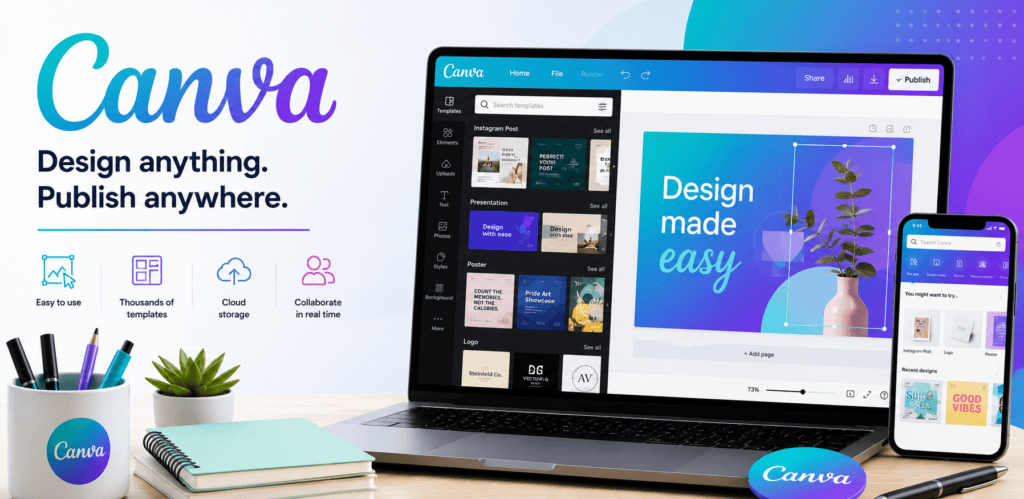
Canva’s core strength hasn’t changed even as its price has: the drag-and-drop editor genuinely doesn’t require design training, and the template library covers an enormous range of formats — social posts, presentations, print materials, video — without needing a second tool for most of a small business’s day-to-day visual needs. For a non-designer who needs to produce professional-looking output quickly, Canva remains hard to beat on ease of use, even against tools with deeper feature sets.
The brand kit and approval-workflow features on Business are a legitimate differentiator for a growing team, not just a price-tier gate for its own sake. Being able to lock a company’s colors, fonts, and logo into every team member’s available assets, and require sign-off before a design publishes, solves a real coordination problem that a collection of individual Pro accounts can’t address on its own.
Where the Limitations Actually Bite
The pricing volatility itself is a legitimate limitation, not just an evaluation inconvenience. A business that budgeted around last year’s Pro or Teams price and is renewing in 2026 may find the number has moved without a correspondingly obvious feature change to justify it — worth checking renewal terms directly rather than assuming auto-renewal will carry the prior rate forward.
The Enterprise seat-minimum gap is a real structural gap for a mid-size business. A 30- to 50-person company that needs single sign-on or advanced audit logs, but isn’t large enough to justify 150 Enterprise seats, is stuck choosing between paying for seats it doesn’t need or doing without security controls that its IT policies might otherwise require. That’s a genuine planning problem worth raising with Canva’s sales team directly rather than assuming a smaller Enterprise commitment is negotiable.
Premium AI video generation billing separately, rather than through the standard credit pool, is easy to miss during evaluation and easy to feel surprised by afterward if a team starts using it regularly without checking the per-generation rate first.
Canva vs. Adobe Creative Cloud vs. Figma
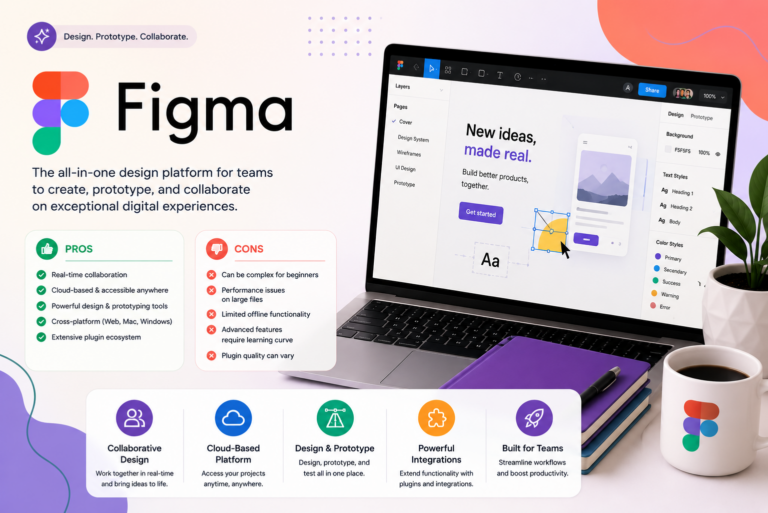
Adobe Creative Cloud remains the deeper tool for a business that needs professional-grade photo editing, video production, or print-ready design work beyond what Canva’s template-driven approach is built for — the tradeoff is a steeper learning curve and, for most individual apps, a higher price than Canva Pro. For a business that already has a Creative Cloud subscription bundling in Adobe Express, that overlap is worth factoring in before also paying for Canva separately.
Figma is the better choice specifically for product and UI design work — interactive prototypes, design systems, and developer handoff — where Canva’s marketing-and-social focus doesn’t really compete. A business doing both marketing design and product design work may reasonably need both tools rather than choosing one over the other.
Canva’s advantage over both is approachability for non-designers producing marketing and social content quickly, and a lower price ceiling for a team that doesn’t need Adobe’s professional-grade depth or Figma’s product-design specialization. AppFinderX’s design and creative software hub covers this broader category comparison in more depth.
Setup and Realistic Expectations
Canva requires essentially no onboarding for basic use — a new user can produce a usable social graphic within minutes of signing up. The learning curve, such as it is, shows up in Business: setting up a proper brand kit, configuring approval workflows, and organizing shared folders for a growing team takes some deliberate setup time, though nothing close to the implementation effort a more complex platform would require.
The Bottom Line
Canva remains a strong choice for a small business or marketing team that needs fast, professional-looking design output without a steep learning curve, and Business is worth the added per-seat cost specifically for teams that need real brand consistency and an approval step before publishing. It’s a weaker fit for a business that needs Adobe’s professional-grade editing depth or Figma’s product-design capabilities, and any business budgeting for Canva in 2026 should build in some buffer for the fact that its pricing has moved upward more than once in the past two years — confirm the live rate before signing an annual contract, and treat AI video generation as a separate cost line if that’s part of the plan.
FAQ
Is Canva’s free plan still usable for a small business? Yes — it includes a large template library and a real, if modest, AI credit allowance, and it’s a legitimate way to evaluate the platform before committing to Pro or Business. It’s not sufficient for a team that needs brand kits or approval workflows.
Why did Canva’s Teams plan become Business? Canva moved from a flat-rate Teams plan to per-seat Business pricing starting in September 2024, then repriced Business again during 2025. The rebrand and the pricing model change happened together, which is part of why older guides describing “Teams at $10/user” no longer reflect current pricing.
Does Canva Pro cover AI video generation? Pro includes access to some AI video tools through the standard Magic Studio credit pool, but Sora-powered premium video generation bills separately, per generation, on top of the subscription. Confirm which AI video features are covered by your credit allowance versus billed separately before relying on it for regular use.
Is Canva Business worth it for a two-person team? It depends on whether shared brand assets and an approval workflow solve a real problem. For two people who don’t need centralized brand control, two individual Pro accounts may be cheaper and entirely sufficient.
Similar Software
- Adobe Creative Cloud — the deeper, more professional-grade alternative for photo editing, video production, and print design beyond Canva’s template-driven scope.
- Figma — the better fit specifically for product and UI design work, which Canva doesn’t compete on directly.
See AppFinderX’s full design and creative software hub for the wider category comparison.
Complementary Software
- Pictory — a natural pairing for a team that needs Canva-designed thumbnails and social graphics to go alongside AI-generated video content.
- Squarespace — a common pairing for a small business publishing Canva-designed graphics directly into a website builder without a separate design handoff step.
- Notion — useful for planning content calendars and briefs upstream of the actual design work happening in Canva.